
Darlington County Criminal Court Cases
Darlington County criminal court cases do not all sit in one court. The South Carolina Judicial Branch courthouse directory places felony and other serious prosecutions in the Circuit Court's General Sessions docket. The Clerk of Court keeps that case file at 110 North Main Street in Darlington and answers at 843-398-4330. The clerk's record may include the charging paper, dated actions, hearing activity, financial entries, filed public documents, the disposition, and the sentence. Prosecutor appearance lists are scheduling records, not statewide criminal histories, and private defendants from those lists should not be republished.
Lower-level criminal, traffic, ordinance, warrant, and bond matters can stay in a magistrate or municipal court. Darlington Area Magistrate is at 115 Camp Road and can be reached at 843-398-4340. Bond Court operates at 2349 Rogers Road. Darlington, Hartsville, Lamar, and Society Hill each have municipal routes for eligible city matters. The citation, case number, court agency, or filed paper is the best clue to the actual custodian. A county search that ignores these summary courts can miss a valid local case.
Darlington County Court Case Routes
The court level matters more than the name of the town where an event occurred. General Sessions handles the serious criminal docket. A magistrate can handle summary offenses, traffic matters, warrants, and the first bond stage. Municipal courts handle eligible city-police and ordinance matters. The same event can also create a sheriff report, a detention record, and a prosecutor file, but those are not the clerk's criminal case file.
| Court route | Typical record | Darlington County contact |
|---|---|---|
| General Sessions | Felony and serious criminal docket | 110 N Main, 843-398-4330 |
| Darlington Area Magistrate | Summary criminal, traffic, and warrant matters | 115 Camp Rd, 843-398-4340 |
| Darlington Municipal | Eligible city-police and ordinance cases | 400 Pearl St, 843-398-4004 |
| Hartsville Municipal | Hartsville tickets and summary matters | 100 E Carolina Ave, 843-383-3008 |
| Lamar Municipal | Eligible town cases | 117 W Main, 843-326-5551 |
| Society Hill Municipal | Municipal matters | 280 S Main, 843-378-4681 |
Hartsville Municipal was listed as a participating Public Index court as of December 1, 2025. Darlington, Lamar, and Society Hill were not on that participating list, so their clerks remain the direct fallback. Participation can change, and the issuing court should confirm the current route.
Searching Darlington County Case Records
The free South Carolina Judicial Branch Case Records Search is the stable online starting point. Select Darlington County rather than relying on a brittle vendor endpoint. The site needs cookies and JavaScript, and a browser may need to allow popups before a case-detail window opens. A name search supports Begins With or Contains. A known case number is stronger, especially for common names. General Sessions numbers follow the pattern year, GS, county code 16, and a sequence.
- Open the statewide Case Records Search and select Darlington County.
- Enter the case number or search the party name with the best available spelling.
- Narrow the result by court agency, court type, case type, action, or date range.
- Open the matching case and inspect Actions, Financials, status, and any document-image icons.
- Call the owning clerk for an absent image, an older case, a municipal file, or a certified copy.
| Field label | Type | Required | Use |
|---|---|---|---|
| Case # | Text | Optional | General Sessions format uses yyyyGSCCxxxxx; county code is 16 |
| Name or business | Text | Optional | Choose Begins With or Contains |
| Party Type | Dropdown | Optional | Narrows by defendant, plaintiff, or another listed role |
| Court Type or Agency | Dropdown | Optional | Targets the court within Darlington County |
| Case Type or SubType | Dropdown | Optional | Separates criminal, civil, appeal, and related categories |
| Action or Date Range | Dropdown and dates | Optional | Filters filed, disposed, judgment, arrest, or docket events |
The Tax Map field is aimed at civil research and is not normally useful for a criminal search. Switch View and arrow controls change how results and party details display. When a name produces too many Darlington County records, add the court agency, case type, or a well-supported date instead of choosing a match from the name alone.
Missing Darlington County Case Documents
A blank image column does not mean that no paper exists. The Public Index is a remote view of selected court data and electronically available filed documents. Image coverage varies by county and case. First check that the detail popup was not blocked. Then note the case number, court agency, filing date, and the exact docket action tied to the desired paper. Those details help the clerk locate the source file.
For a modern General Sessions matter, call the Darlington County Clerk at 843-398-4330 and ask whether the record is electronic, paper, archived, or available for certification. Contact the named municipal clerk for a city case that is not indexed. No official local per-page or certification schedule was located in the research, so request a current cost estimate before ordering. For surviving historic General Sessions journals, the South Carolina Department of Archives and History county guide is a separate archive channel.
Note: Missing online images call for a clerk inquiry, not a guess that the filed document or Darlington County case does not exist.
Inside a Darlington County Case File
A Darlington County case file records the court's work after a charge reaches the docket. It may show what was formally filed, not just what an officer alleged at arrest. The prosecutor can amend a charge, a grand jury can return a true bill or no bill, and a court can dismiss or resolve a count by plea or trial. Read the dated Actions beside the status and disposition. One field alone rarely tells the full path.
| Case number and court | Identifies the docket, court type, and owning Darlington County court agency. |
|---|---|
| Parties and roles | Names public case parties and identifies their role in the action. |
| Charge and case type | Shows the filed category, subtype, or charging instrument when public. |
| Docket actions | Lists dated court events, motions, hearings, and status changes. |
| Financials | Shows court financial entries, which are not a criminal-history report. |
| Disposition and sentence | Records how a filed charge ended and any sentence entered by the court. |
Home addresses were removed from new and existing public-index cases beginning January 1, 2026. Sealed cases, confidential reference lists, sensitive identifiers, and other protected material do not become public just because the docket is online.
Correcting Darlington County Case Records
A typo in the Public Index follows a different correction path from an error in a SLED repository report. Under Judicial E-Filing Rule 11, a data-entry correction request goes in writing to the clerk. Identify the Darlington County court, case number, field at issue, and the source document that supports the change. The clerk controls docket data. The solicitor, sheriff, jail, and public defender cannot edit that court index.
If the court file is right but a SLED criminal-history report is wrong, the separate route is SLED's Public Dissemination Unit. A still-visible expunged charge should be supported with the certified order. Fixing the Darlington County docket does not prove that every downstream system has refreshed, so review each official source that carried the error. A spelling or custody-status issue on the jail page belongs with the W. Glenn Campbell Detention Center, not the court clerk.
How a Criminal Case Moves
A Darlington County criminal court case can begin with an arrest or citation. Custodial cases add booking and a bond stage. The prosecutor then reviews the allegation, while a complaint or indictment supplies the charging path that applies. Arraignment is the formal plea stage. Pretrial motions and hearings resolve evidence, scheduling, and legal issues before a plea or trial. The disposition tells how the filed count ended, and sentencing states the punishment or conditions after a conviction.
Case flow: Charges Filed › Arraignment › Pretrial › Plea or Trial › Disposition › Sentencing
Published sources did not give an exact local time from arrest to hearing or final result. Do not treat the flow as a fixed clock. A municipal citation, General Sessions indictment, and appealed summary matter can move on very different schedules. The action log is the best public timeline for the specific Darlington County case.
Darlington County Court Record Holders
The Fourth Circuit Solicitor prosecutes General Sessions matters and keeps a prosecutor file. The Clerk of Court keeps the public court file. The circuit public defender represents qualifying people appointed by the court, but that office is not a public-record request desk. These offices may touch the same case without holding the same material. A request for a docket or certified judgment belongs with the clerk, while a question about prosecution scheduling belongs with the solicitor.
The South Carolina Commission on Indigent Defense profile shows the Darlington County public defender office at 300 Russell Street, Room 113, with phone 843-398-4069.
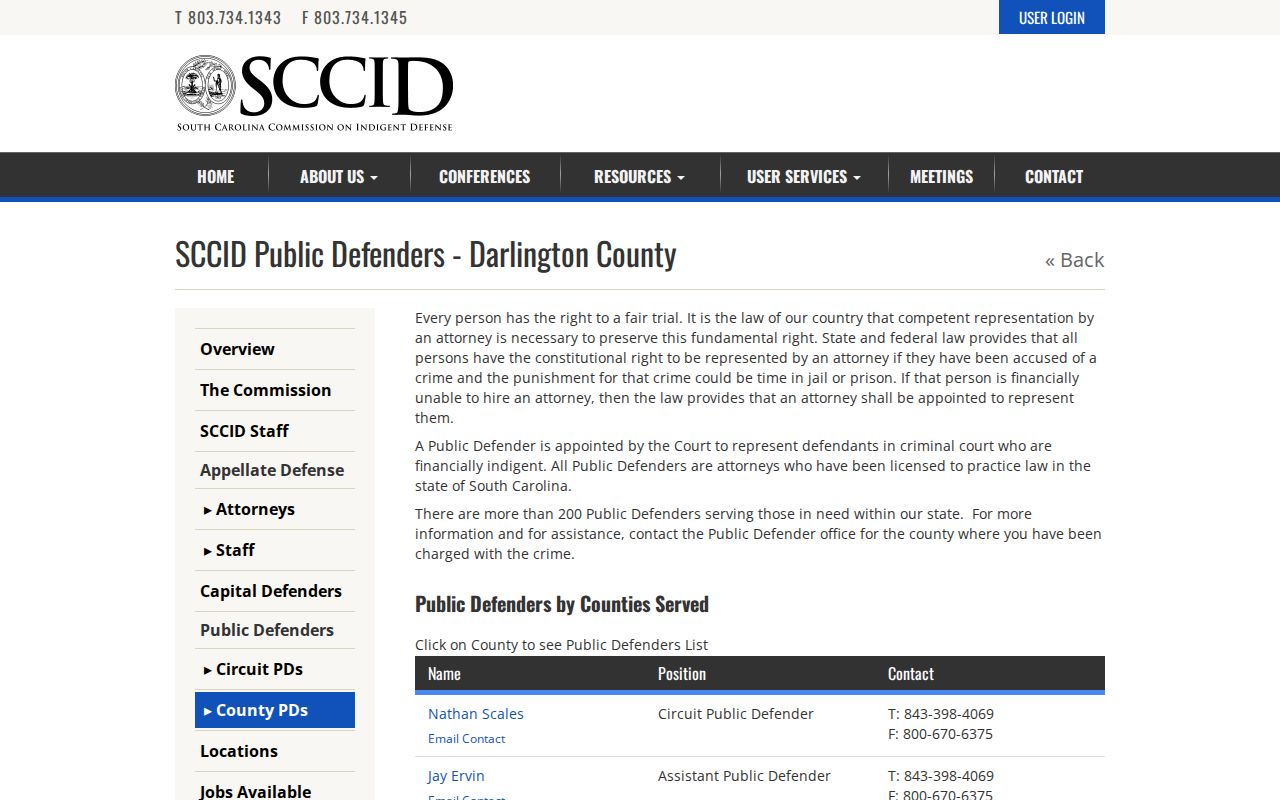
The office image helps identify a defense-services channel, while the Darlington County Clerk remains the custodian for the public criminal court case record.
Case Record Access & Restrictions
South Carolina court records begin with a strong public-access rule, but public access does not expose every field. Judicial E-Filing Rule 10 permits access to public case status and filed documents while preserving sealed and sensitive material. The South Carolina Freedom of Information Act also supports inspection and copying from public bodies, subject to lawful redaction and exemptions. Court rules govern the judicial file itself.
Juvenile material, sealed cases, victim information, confidential identifiers, and records whose release would harm a fair trial or safety can be limited. Ask for the segregable public part rather than assuming the whole Darlington County file must be withheld. An expunged or sealed entry should not be evaded through another system. When a public case does not appear, confirm the spelling and court, then ask the clerk whether the matter is local, archived, restricted, or simply absent from the remote index.
Darlington County Criminal Journals After 1806
Darlington County's record history has a sharp break. A courthouse fire in 1806 destroyed most early county records. Surviving General Sessions journals begin in that year, which explains why a modern search tool cannot supply every older criminal entry. The archive guide, not the Public Index, is the better starting point for historical or genealogical work tied to those journals.
For later records, start with the current clerk and ask how the file is stored. A paper, microfilmed, or archived Darlington County case may not have a clickable image. Give the court, approximate year, name, and case number when known. That focused request lets staff distinguish a missing online image from a record lost to history. It also keeps the search tied to the source instead of a broad name match with no docket context.