
Sex Offender Checks in Darlington County
The South Carolina Public Sex Offender Registry is the main public channel for a Darlington County sex offender check. It is free, statewide, and separate from SLED CATCH. CATCH is a paid name-based criminal-history product, but its terms exclude sex-offender searches. The registry answers the narrower question of whether a person is required and eligible to appear under South Carolina's registration law. That distinction matters. A CATCH result cannot replace a registry search, and the absence of a CATCH entry says nothing about registration status.
Start with enough detail to avoid a weak name match. A full name and alias can help with a named-person query. A city, county, or ZIP-zone inquiry works better for community awareness when no person is known. Then compare the identifying traits, conviction data, photo, and address on any result. Darlington County users should save the search date because registry facts can change. When the portal is down or CAPTCHA does not load, try again later or call SLED or the Darlington County Sheriff's Office. A technical failure is not a clear result.
Darlington County SORT Registry Gateway
SLED's current Darlington County registry route refers users to its newer SORT management application. The opening gate requires CAPTCHA, a test meant to block automated traffic. Research did not safely expose every live dropdown or map control behind that gate, so radius values and map or list toggles should not be assumed. The statute supplies the safer minimum: a request may be framed around a person, city, county, or ZIP zone. Exact screen labels can change even when those lawful search paths remain.
The official SLED registry entrance shows that gateway before any individual profile is opened.
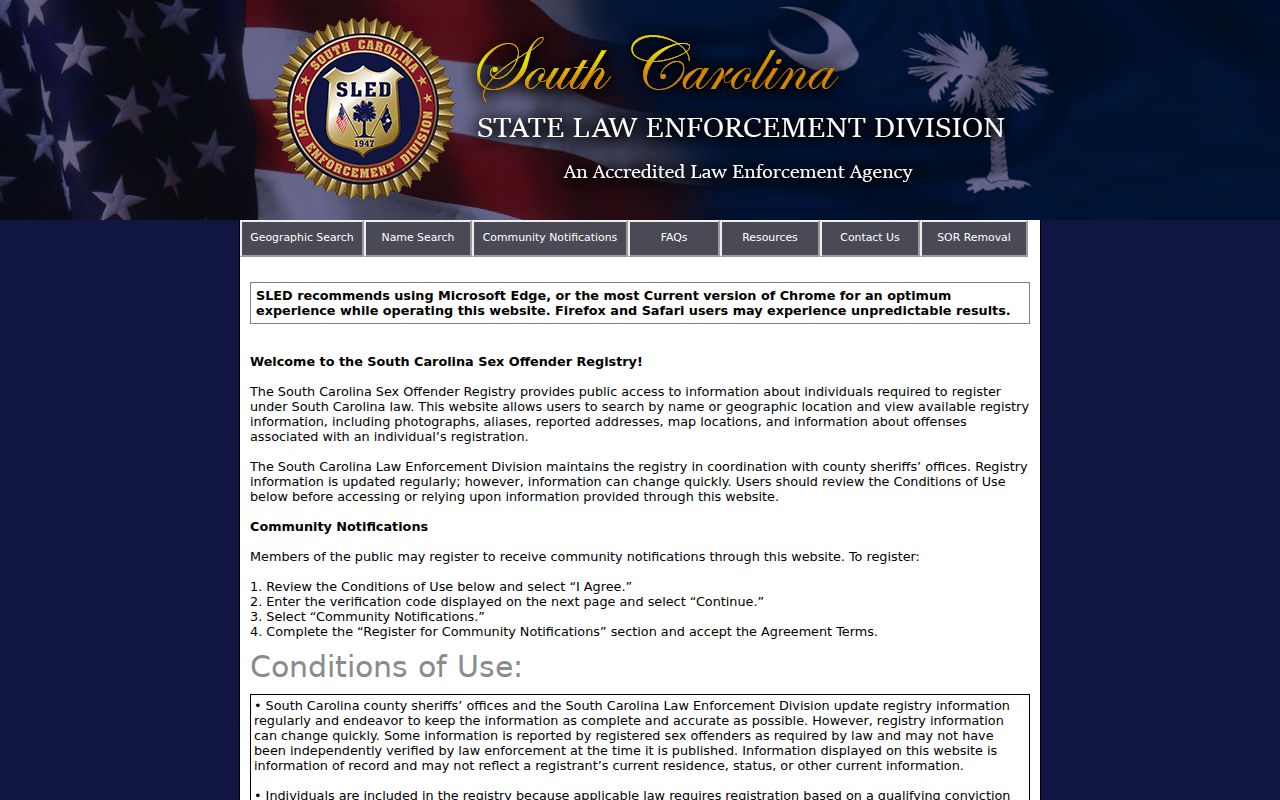
The image helps a Darlington County searcher recognize the official entrance without displaying or republishing a private person's registry profile.
How to Search the South Carolina Public Sex Offender Registry
A careful Darlington County sex offender registry search follows the official controls and stops short of guessing at fields the new interface may not expose. Use the county filter for a broad local check, or add known personal details for a more focused comparison. Review each candidate on the official site rather than relying on a search-engine snippet. A current photo and address can aid identification, but neither alone proves that two people with a similar name are the same person.
- Open SLED's registry gateway and complete the required CAPTCHA.
- Choose a supported route, such as name, city, Darlington County, or ZIP zone.
- Compare the result with known identifiers, including aliases, birth date, physical traits, and conviction place.
- Open the official profile and note its address, offense, conviction facts, photo, and the date of the check.
The fields below separate what South Carolina law supports from controls that were not verified during the portal review.
| Field or Control | Status | Search Use | Limits |
|---|---|---|---|
| CAPTCHA | Required gateway | Complete before searching | A failed challenge is not a no-result finding |
| Name | Statute-supported | Search a known person or alias | Confirm the match with more than the name |
| City, county, or ZIP zone | Statute-supported | Frame a Darlington County area search | Exact live labels were not safely rendered |
| Radius, map, or list toggles | Not verified | Do not rely on an assumed option | Check the live gateway for current controls |
Darlington County Registry Across State Lines
A Darlington County search is only one geographic layer. The National Sex Offender Public Website, or NSOPW, combines public registry searches from participating jurisdictions. It is useful when a person has lived in another state, when an address lies near a state line, or when the relevant place is not known. NSOPW does not turn the underlying state files into a single national criminal-history report. Each state still controls who must register, what becomes public, and how often its information changes.
The official NSOPW search page shows the cross-state route available to Darlington County residents.
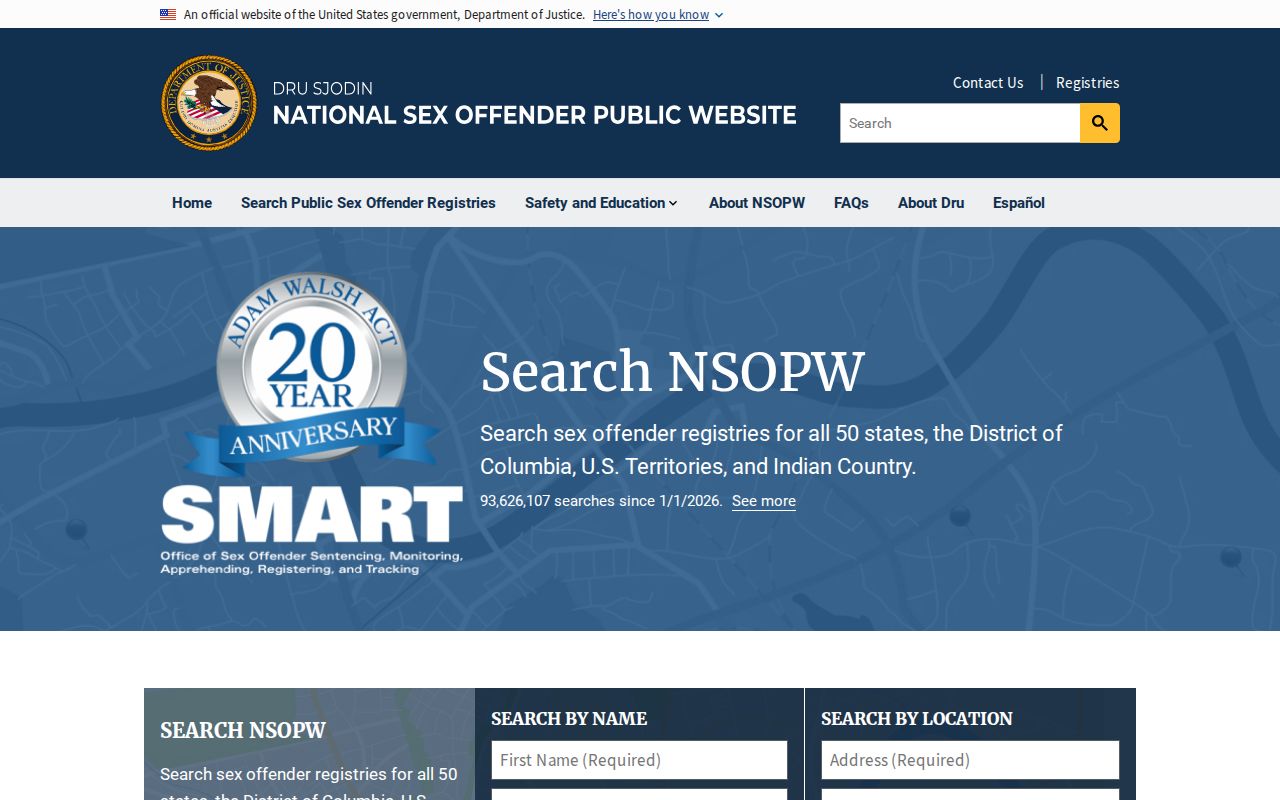
This national layer is best used as a second check. Return to the source state's profile for the full public entry and its local terms.
Coverage also has a legal boundary. The public registry is not proof of every sexual offense. It contains people whom law requires to register and whose data may be shown to the public. Limited juvenile information, an allowed removal, a reporting lag, or a portal fault can all affect what appears. Darlington County community awareness should rest on current official entries, not an inference drawn from silence.
Inside a Registry Profile
South Carolina Code §23-3-490 sets the public baseline for a registry profile. It covers identifying and conviction facts that help a Darlington County user distinguish one person from another. SLED collects other data for registry administration under separate law, but collection does not make every item public. Social Security numbers, internet identifiers, work details, vehicle data, tattoos, and school ties should not be treated as public profile fields without live confirmation from the official system.
| Names and Aliases | Full registered names and known aliases used to narrow identity. |
|---|---|
| Physical Description | Identifying physical traits plus date of birth for comparison. |
| Current Photo | A current public image used with other identifiers, not as the sole match. |
| Home Address | The public registered residence provided under §23-3-490. |
| Qualifying Offense | The offense that supports registration, rather than every prior allegation. |
| Conviction Details | The conviction date and the city and state where it occurred. |
Tier is a legal category tied to the qualifying offense. It is not a forecast of conduct and should never be called a risk score.
Darlington County Registry Notification Distances
South Carolina uses two distance rules that answer different questions. When a registered address is within one-half mile of a school or daycare, the sheriff has a notification duty to the administrators. That is a notice rule. Section 23-3-535 also creates a 1,000-foot residence limit, but only for specified offenders covered by its terms. It does not apply to every registrant in Darlington County. Combining the two standards would wrongly turn a notice zone into a universal residence ban.
The Darlington County Sheriff's Office is the local point for registration and suspected noncompliance. Its official county page lists headquarters at 1621 Harry Byrd Highway, Darlington, SC 29532, and 843-398-4501 or 843-398-4502. The research did not identify a separate public registration-unit counter or fixed verification schedule. Call first for the right staff member and current procedure rather than assuming normal county office hours are registry-counter hours.
Note: The half-mile notice rule and selected-offender 1,000-foot limit should be checked separately before drawing any conclusion about an address.
South Carolina Registration Levels and Requirements
South Carolina's tiers define offense categories and possible removal routes. They are not automatic expiration dates. Tier I and Tier II registrants may become eligible to apply to SLED after a set period, but treatment, criminal history, failure-to-register history, records, prosecutor notice, and agency review still matter. Tier III uses a court process instead. A Darlington County Tier III request begins with a General Sessions petition after the statutory period and requires proof by the clear-and-convincing standard, which means the judge must be firmly persuaded by the evidence.
| Tier | Illustrative Basis | Earliest Removal Route |
|---|---|---|
| Tier I | Enumerated offenses including third-degree criminal sexual conduct and specified voyeurism or other offenses | May apply to SLED after 15 years if all conditions are met |
| Tier II | Enumerated more serious offenses, including specified minor-exploitation and solicitation offenses | May apply to SLED after 25 years if all conditions are met |
| Tier III | First-degree criminal sexual conduct, specified child offenses, qualifying kidnapping, or repeat registration | May petition General Sessions after 30 years with the required showing |
For Tier I or II, SLED calls for a $250 nonrefundable cashier's check or money order, fingerprints, two FD-258 cards, state and federal checks, disposition and sentencing records, and treatment proof. Review may take up to 120 days, and a prosecutor may object. A denial starts a wait of at least five years before another request. Tier III also has counsel or appointed-counsel provisions and the same five-year denial interval. The full case record tied to a Darlington County petition can be traced through Darlington County criminal court cases.
Darlington County Registry Removal Is Conditional
The phrase “15 years” does not mean that a Tier I entry vanishes on its anniversary. The same is true at 25 years for Tier II and 30 years for Tier III. Those periods mark a possible application or petition point. SLED or the court must still decide whether the person meets every requirement. Treatment proof, a disqualifying new offense, a recent registration failure, missing records, and a prosecutor's objection can change the outcome.
SLED's official registry and removal guidance illustrates the administrative path and the documents it requires.
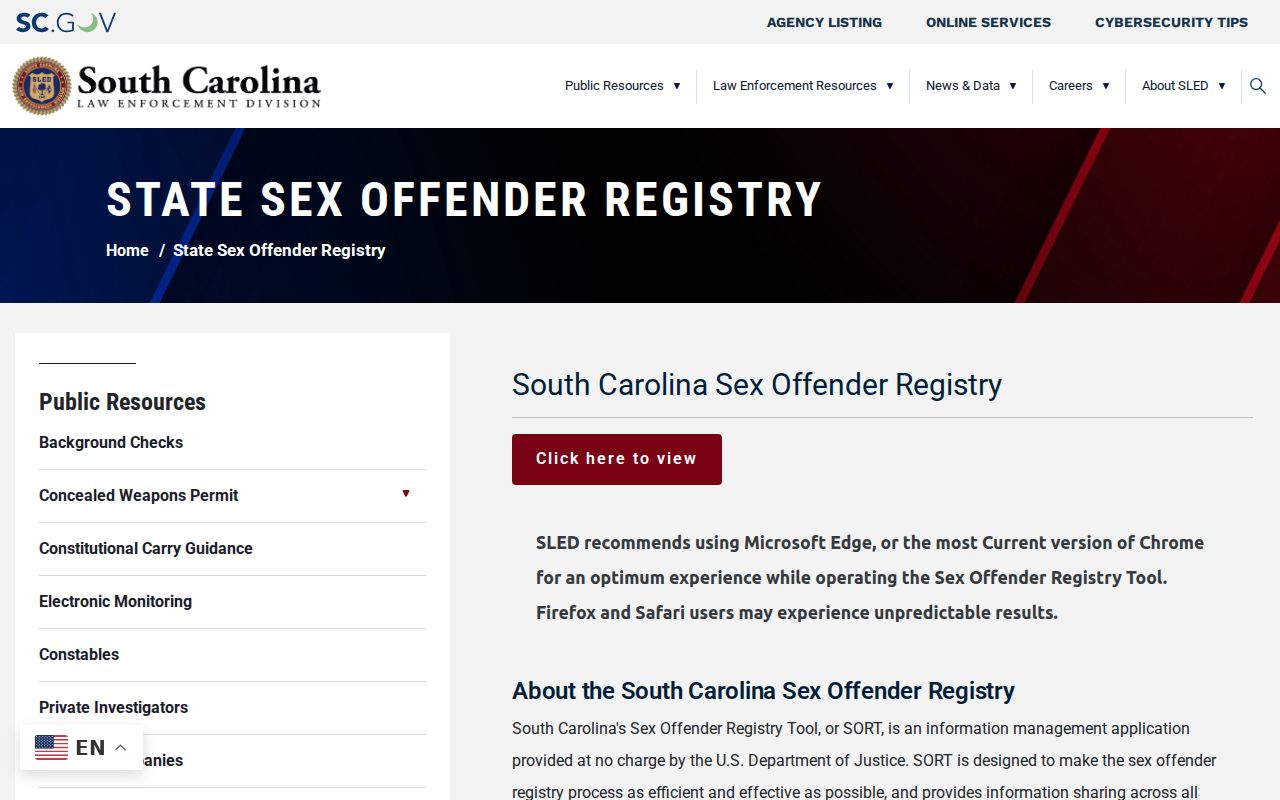
The guidance reinforces the key point for Darlington County records: eligibility to ask for removal is not the same as removal, and a denied request does not shorten the next waiting period.
Report Darlington County Registry Noncompliance
Suspected noncompliance should go to law enforcement, not to a confrontation. Record the public profile URL, the date of the search, and the specific fact that appears inconsistent. Then contact the Darlington County Sheriff's Office or SLED through an independently verified official channel. Describe what was observed without claiming a crime has occurred. Officers can compare the report with nonpublic registration data and decide whether follow-up is needed.
Do not post an accusation, visit an address, threaten a household, or organize informal enforcement. A stale profile or misunderstood address rule can produce a false claim. The Darlington County registry supports awareness, while trained agencies handle verification and investigation. In an immediate emergency, use emergency services. For a routine registry question, the sheriff's official phone line is the safer local route.
Note: Save the official profile and search date, but let DCSO or SLED decide whether a reporting or address violation exists.
Community Notification and Lawful Use
Registry information serves personal and family safety, neighborhood awareness, and informed community planning. Read it narrowly. A profile states that a person meets South Carolina's legal registration criteria and reports the public facts authorized by law. It does not authorize harassment or vigilantism. It also does not turn an offense tier into a risk rating. Verify a match on the official record, keep the search date, and direct concerns to the Darlington County Sheriff's Office or SLED.
South Carolina Code §23-3-510 adds punishment when registry information is used to commit another crime. The rule protects lawful awareness while drawing a firm line against using public data as a tool for threats, intimidation, property damage, or other criminal conduct.
Registry misuse can add criminal penalties: Do not use Darlington County registry information to harass, threaten, intimidate, or commit another crime. Report a safety concern or suspected registration violation to DCSO or SLED.